Surrogacy of intermediate clinical endpoints for overall survival in BCG-naïve high-risk non-muscle-invasive bladder cancer
EFS/PFS track with OS but are not robust surrogates yet.
Lun-Hsiang Yuan, MD, PhD · 5 min read
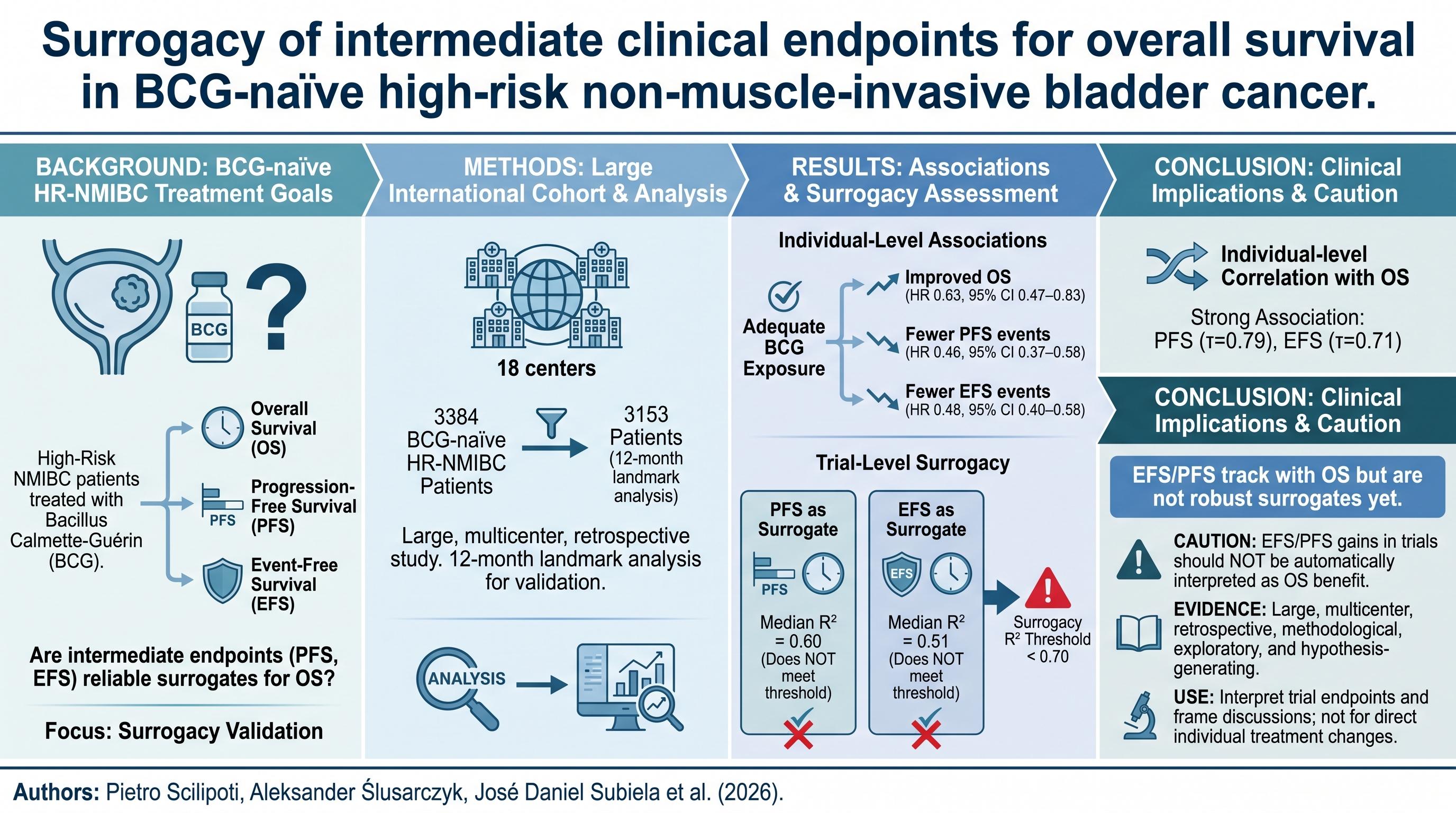
Key points
- Across 18 international centers, 3384 BCG-naïve HR-NMIBC patients were analyzed, with 3153 entering the 12-month landmark analysis.
- Adequate BCG exposure was associated with improved OS: HR 0.63, 95% CI 0.47–0.83.
- Adequate BCG was also associated with fewer PFS events (HR 0.46, 95% CI 0.37–0.58) and EFS events (HR 0.48, 95% CI 0.40–0.58).
- Individual-level association with OS was strong for PFS (τ=0.79) and EFS (τ=0.71).
- Pseudo-trial-level surrogacy did not meet the prespecified threshold: median R2 0.60 for PFS and 0.51 for EFS, below ≥0.70.
Review
Recent trials in BCG-naïve high-risk non–muscle-invasive bladder cancer (HR-NMIBC) have increasingly added immunotherapy to BCG and often used event-free survival (EFS) as the primary endpoint. Yet neither EFS nor progression-free survival (PFS) has been validated as a surrogate for overall survival (OS) in this setting. This retrospective study analyzed patients treated across 18 international centers between 2001 and 2025, using adequate BCG exposure, defined by International Bladder Cancer Group criteria, as the treatment contrast. Among 3384 patients, 3153 entered the 12-month landmark analysis, and 2697 (85.5%) had adequate BCG exposure. Median follow-up was 50 months (IQR 17–77). The investigators used inverse probability of treatment weighting (IPTW) and adjusted Cox models to assess effects on OS and intermediate clinical endpoints, then tested surrogacy through adapted Prentice criteria and an emulated two-stage meta-analytic framework, including individual-level Kendall’s τ and pseudo-trial-level R2 across 500 random pseudo-trial replications. Adequate BCG was associated with improved OS (HR 0.63, 95% CI 0.47–0.83), lower risk of PFS events (HR 0.46, 95% CI 0.37–0.58), and lower risk of EFS events (HR 0.48, 95% CI 0.40–0.58). Both PFS and EFS were independently associated with OS, with strong individual-level associations: τ=0.79 (95% CI 0.75–0.83) for PFS and τ=0.71 (95% CI 0.66–0.75) for EFS. However, adjustment for either endpoint did not fully attenuate the BCG effect on OS. At the pseudo-trial level, surrogacy was only moderate, with median R2 values of 0.60 for PFS and 0.51 for EFS, both below the prespecified adequacy threshold of ≥0.70 and with wide dispersion across replications. The authors appropriately frame this as exploratory and hypothesis-generating, concluding that EFS and PFS may not fully capture treatment effects on OS in BCG-naïve HR-NMIBC.
Clinical Significance
Clinically, this study cautions that EFS or PFS gains in BCG-naïve HR-NMIBC trials should not be automatically interpreted as OS benefit. The evidence is large, multicenter, retrospective, and methodologically careful, but exploratory and hypothesis-generating. It is most useful for interpreting trial endpoints and framing discussions, rather than directly changing individual treatment choices.