Distinct Prognostic Roles of Grade Group and Intraductal Carcinoma of the Prostate in Metastatic Hormone-Sensitive Prostate Cancer Treated With Androgen Receptor Signaling Inhibitors
In ARSI-treated mHSPC, GG 5 and IDC-P appear prognostically distinct.
Lun-Hsiang Yuan, MD, PhD · 4 min read
Key points
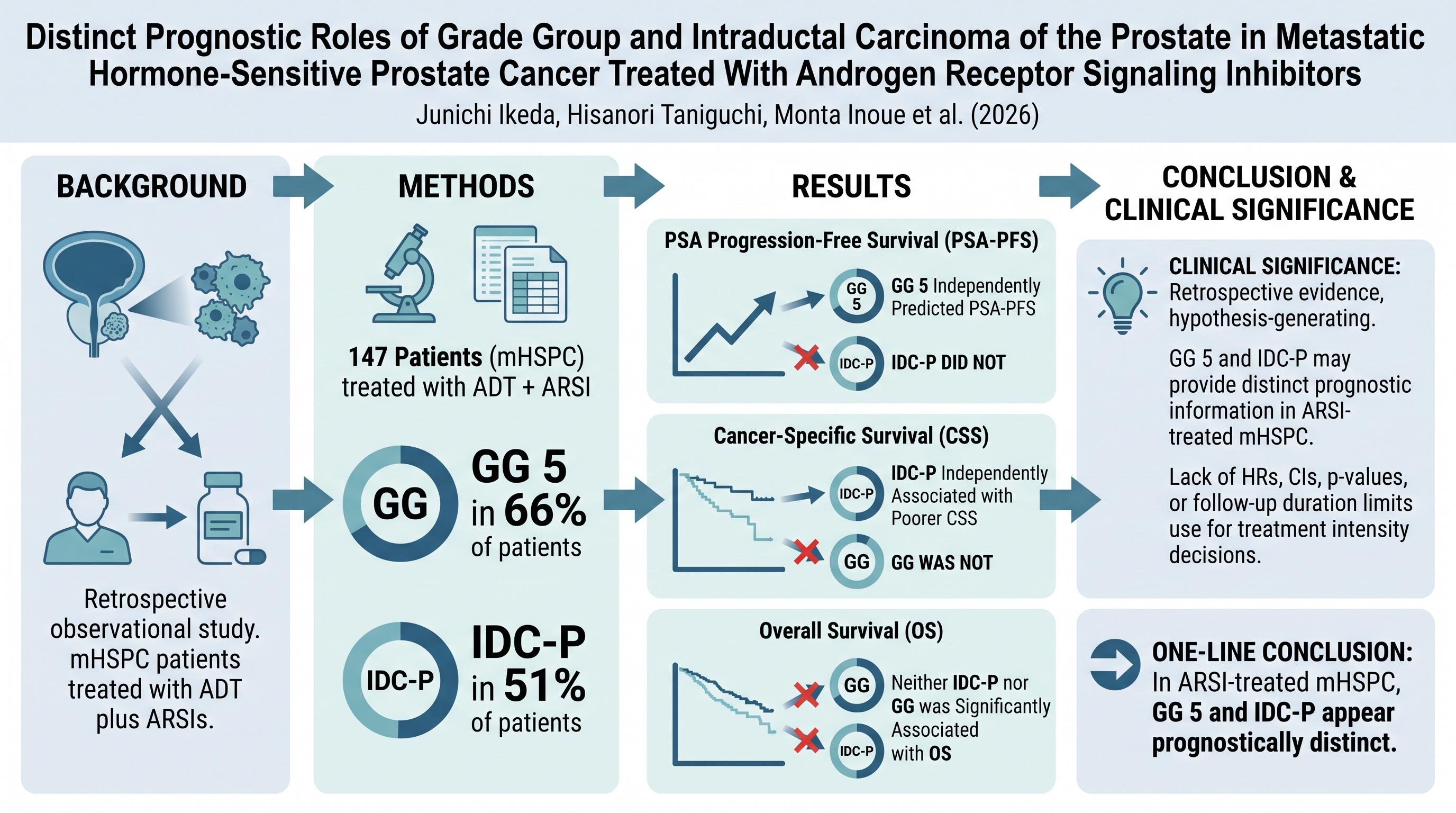
- This retrospective study included 147 patients with mHSPC treated with ADT plus ARSIs.
- GG 5 was identified in 66% of patients, and IDC-P was present in 51%.
- GG 5 independently predicted PSA-PFS, whereas IDC-P did not.
- IDC-P was independently associated with poorer CSS, whereas GG was not.
- Neither IDC-P nor GG was significantly associated with OS.
Review
As androgen receptor signaling inhibitors (ARSIs) have become central in metastatic hormone-sensitive prostate cancer (mHSPC), whether conventional pathologic factors still carry clinically useful prognostic information is an important practical question. This retrospective study analyzed 147 patients with mHSPC treated with androgen deprivation therapy plus an ARSI, specifically abiraterone acetate, enzalutamide, or apalutamide. The investigators assessed associations between clinicopathologic factors, including Grade Group (GG) 5 and intraductal carcinoma of the prostate (IDC-P), and three clinical endpoints: PSA progression-free survival (PSA-PFS), cancer-specific survival (CSS), and overall survival (OS). Kaplan-Meier analysis and Cox proportional hazards models were used. GG 5 was present in 66% of patients, and IDC-P was present in 51%. The main finding was that GG 5 independently predicted PSA-PFS, whereas IDC-P did not. Conversely, IDC-P was independently associated with poorer CSS, whereas GG was not. Neither IDC-P nor GG was significantly associated with OS. The authors also reported that combined assessment of GG 5 and IDC-P showed the best prognostic predictive ability for PSA-PFS, CSS, and OS. Clinically, the paper is valuable because it suggests these two pathology variables may capture different prognostic dimensions in ARSI-treated mHSPC. However, this remains a retrospective analysis; the abstract does not provide hazard ratios, confidence intervals, p values, follow-up duration, or external validation. The findings should therefore be interpreted as hypothesis-generating risk stratification data rather than as evidence to mandate treatment selection by GG or IDC-P alone.
Clinical Significance
This is retrospective observational prognostic evidence and should be viewed as hypothesis-generating. Its practical value is that GG 5 and IDC-P may provide distinct prognostic information even in ARSI-treated mHSPC. Because the abstract does not report HRs, CIs, p values, or follow-up duration, these factors should not be used alone to dictate treatment intensity.