Outcomes and Predictive Factors for Gynecologic Organ Involvement in Radical Cystectomy for Female Bladder Cancer Patients: A Multicenter Retrospective Cohort Study
Gynecologic organ involvement is uncommon but prognostically relevant in female radical cystectomy.
Lun-Hsiang Yuan, MD, PhD · 3 min read
Key points
- This multicenter retrospective cohort included 232 women undergoing radical cystectomy at 13 tertiary centers.
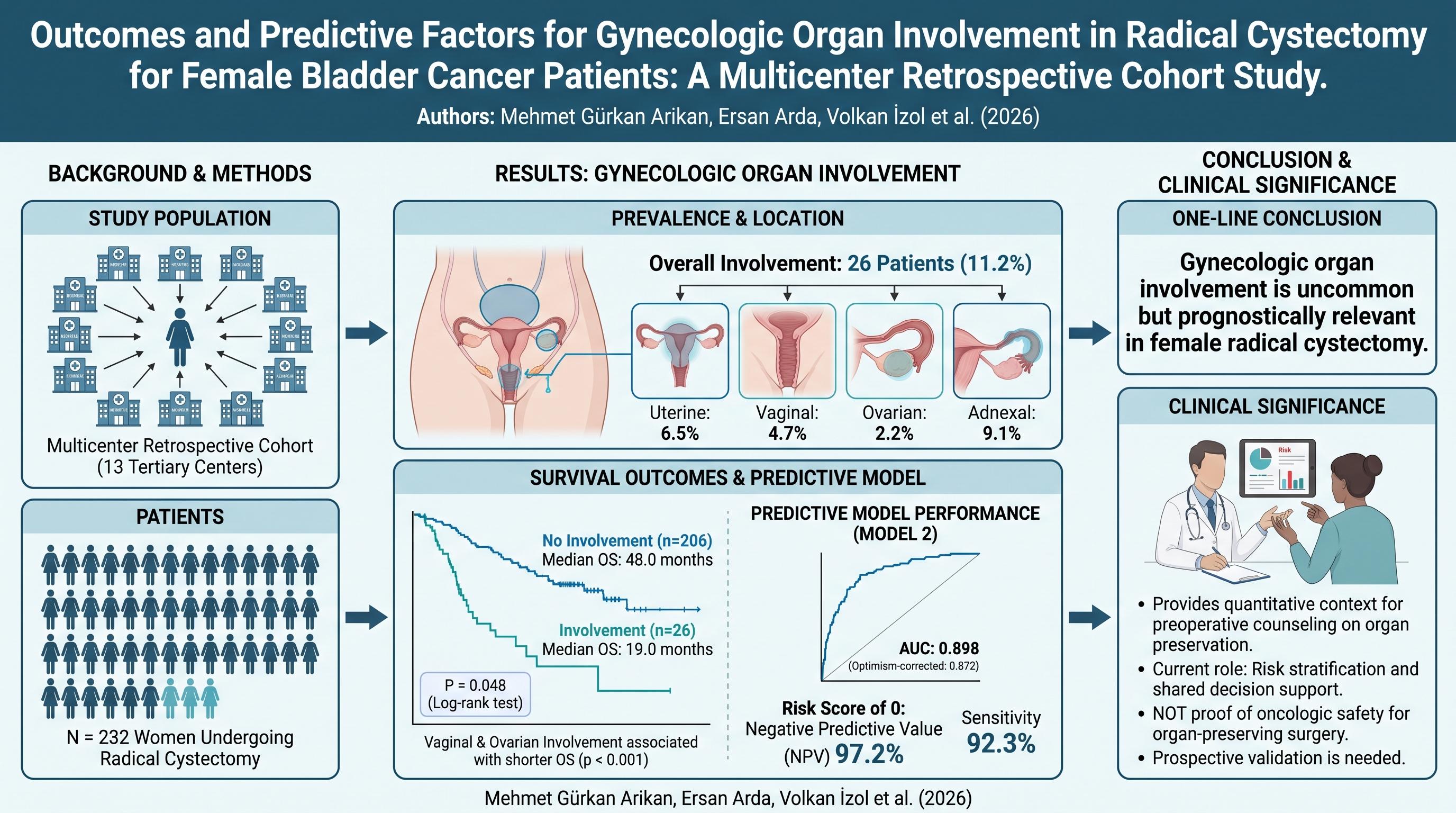
- Pathologic gynecologic organ involvement occurred in 26 patients (11.2%), including uterine 6.5%, vaginal 4.7%, ovarian 2.2%, and adnexal 9.1%.
- Median OS was shorter with gynecologic organ involvement than without involvement (19.0 vs. 48.0 months; p = 0.048).
- Vaginal and ovarian involvement were associated with shorter OS (both p < 0.001), whereas uterine and adnexal involvement were not.
- Model 2 showed an AUC of 0.898 and optimism-corrected AUC of 0.872; a risk score of 0 had an NPV of 97.2% and sensitivity of 92.3%.
Review
In women undergoing radical cystectomy for bladder cancer, gynecologic organ preservation remains a difficult balance between oncologic safety and quality-of-life considerations. This multicenter retrospective cohort study included 232 women treated with radical cystectomy at 13 tertiary centers; 182 had clinical T2 disease and 50 had BCG-unresponsive or very-high-risk Ta/T1 non-muscle-invasive bladder cancer. Overall survival (OS) was the primary endpoint, with cancer-specific survival and recurrence-free survival as secondary outcomes. Multivariable logistic regression was used to identify predictors of pathologic gynecologic organ involvement and to develop preoperative prediction models. Pathologic gynecologic organ involvement was found in 26 patients (11.2%): uterine involvement in 15 (6.5%), vaginal in 11 (4.7%), ovarian in 5 (2.2%), and adnexal in 21 (9.1%). Median OS was shorter in patients with involvement than in those without involvement (19.0 vs. 48.0 months; p = 0.048). Vaginal and ovarian involvement were associated with shorter OS (both p < 0.001), whereas uterine and adnexal involvement were not. Pathologic T stage was associated with organ involvement (p = 0.001), with the highest frequency in pT4 disease. Among the prediction models, Model 2 achieved an AUC of 0.898 and an optimism-corrected AUC of 0.872. A risk score of 0 classified 31.0% of patients as low risk, with an NPV of 97.2% and sensitivity of 92.3%. The authors interpret these findings as supportive of preoperative risk stratification, while emphasizing that the oncologic safety of organ-preserving surgery cannot be established from pathologic involvement data alone.
Clinical Significance
Clinically, this study offers quantitative context for preoperative counseling about gynecologic organ preservation in women undergoing radical cystectomy. The evidence is from a multicenter retrospective cohort; despite promising model performance, prospective validation is needed. Its current role is risk stratification and shared decision support, not proof of oncologic safety for organ-preserving surgery.