Survival Benefit of ARSI Therapy in Japanese mCSPC: A Systematic Review and Meta-Analysis
In Japanese mCSPC, ARSI therapy was associated with better OS.
Lun-Hsiang Yuan, MD, PhD · 4 min read
Key points
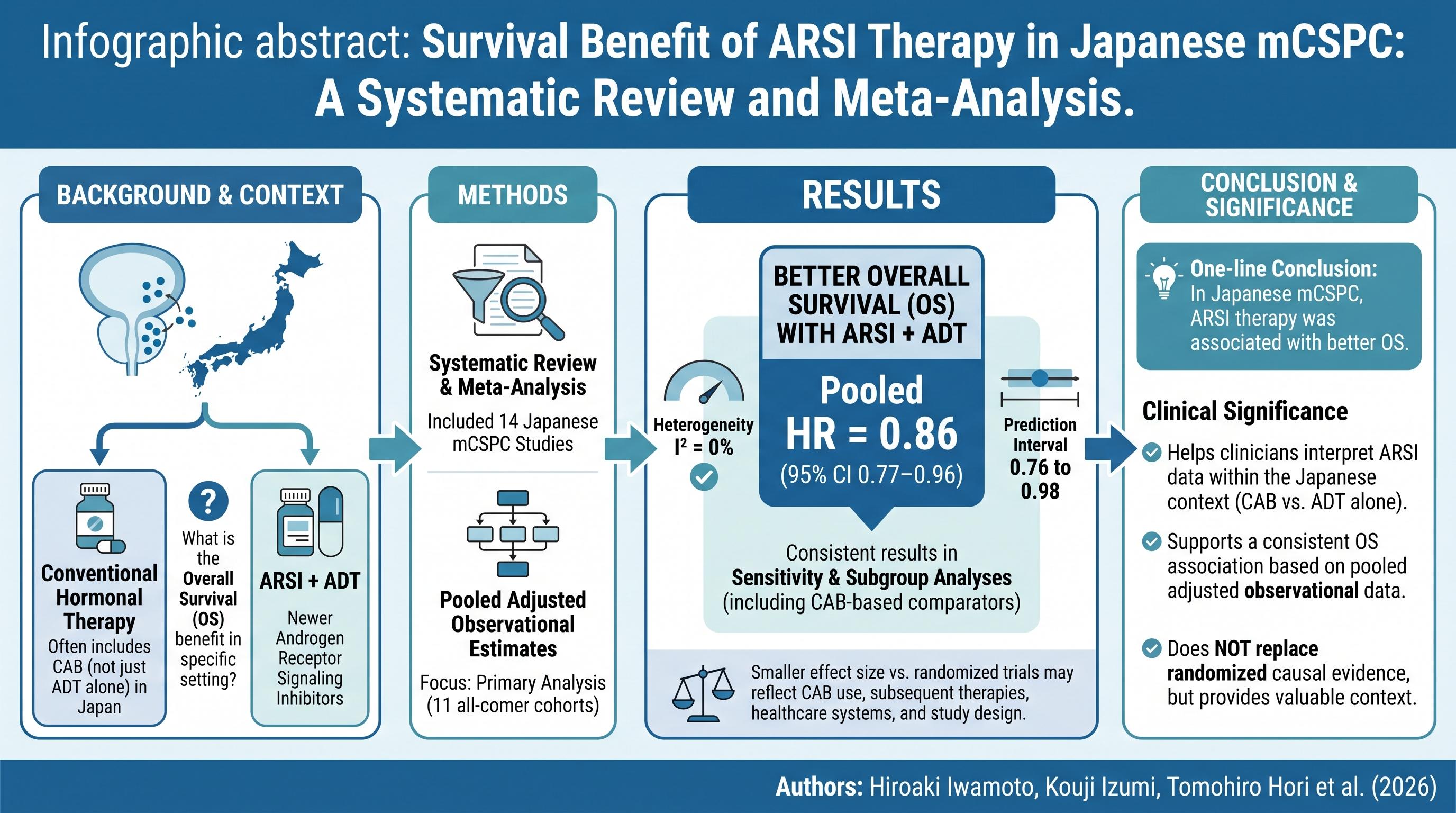
- The meta-analysis included 14 Japanese mCSPC studies, with 11 all-comer cohorts in the primary analysis.
- ARSI plus ADT was associated with better OS than conventional hormonal therapy, with a pooled HR of 0.86 (95% CI 0.77–0.96).
- The primary analysis showed no heterogeneity (I2=0%) and a prediction interval of 0.76 to 0.98.
- Sensitivity and subgroup analyses, including CAB-based comparator cohorts, showed consistent results.
- The authors note that the smaller effect size versus randomized trials may reflect CAB use, subsequent therapies, healthcare systems, and study design.
Review
Second-generation androgen receptor signaling inhibitors (ARSIs) plus androgen deprivation therapy (ADT) have improved overall survival (OS) in randomized trials of metastatic castration-sensitive prostate cancer (mCSPC). The key clinical question here is contextual: in Japan, combined androgen blockade (CAB) has long been used as conventional hormonal therapy, whereas many Western trials used ADT alone as the main comparator. This PRISMA 2020 systematic review and meta-analysis, registered in PROSPERO (CRD420261380244), examined whether ARSI plus ADT is associated with an OS benefit versus conventional hormonal therapy, defined as ADT alone or CAB, in Japanese patients with mCSPC. PubMed and Ichushi-Web were searched through February 2026. The authors pooled adjusted hazard ratios from multivariable or propensity score-matched analyses using a random-effects model, and assessed risk of bias with ROBINS-I. Fourteen studies were included; 11 all-comer mCSPC cohorts formed the primary analysis. ARSI-based therapy was associated with improved OS compared with conventional hormonal therapy, with a pooled HR of 0.86 (95% CI 0.77–0.96), no heterogeneity (I2=0%), and a prediction interval of 0.76 to 0.98. Sensitivity and subgroup analyses, including CAB-based comparator cohorts, were consistent. The authors conclude that ARSI-based therapy is associated with a modest but consistent OS improvement in Japanese mCSPC. They also emphasize that the attenuated effect size compared with randomized trials may reflect baseline treatment strategies, subsequent therapies, healthcare systems, and study design. Because the pooled estimates come from adjusted observational analyses, the evidence is clinically useful but should be interpreted as contextual rather than definitive causal proof.
Clinical Significance
This study helps clinicians interpret ARSI data within the Japanese mCSPC treatment context, where conventional therapy may include CAB rather than ADT alone. The evidence is a systematic review and meta-analysis, but it pools adjusted observational estimates, so it supports a consistent OS association without replacing randomized causal evidence.