Efficacy and safety of combination versus single-agent immunotherapy for BCG-unresponsive non-muscle-invasive bladder cancer
Combination immunotherapy shows better short-term outcomes in BCG-unresponsive NMIBC, but needs RCT confirmation.
Lun-Hsiang Yuan, MD, PhD · 4 min read
Key points
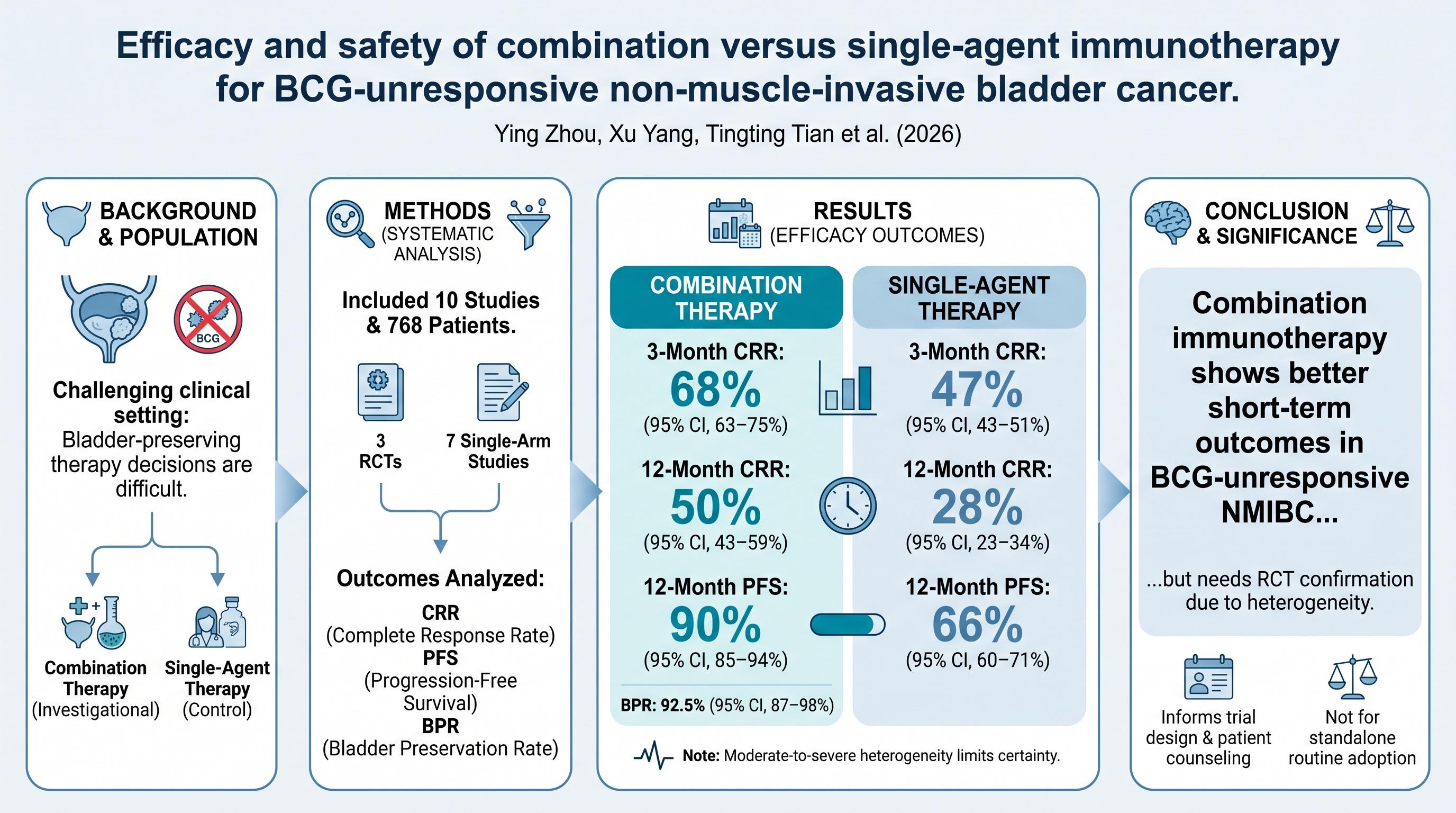
- This systematic analysis included 10 studies and 768 patients with BCG-unresponsive NMIBC, comprising 7 single-arm studies and 3 RCTs.
- For the primary endpoint of CRR, 3-month rates were 68% (95% CI, 63–75%) with combination immunotherapy versus 47% (95% CI, 43–51%) with monotherapy.
- At 12 months, CRRs were 50% (95% CI, 43–59%) with combination therapy and 28% (95% CI, 23–34%) with single-agent therapy.
- The abstract reports a significantly higher 12-month PFS rate with combination therapy: 90% (95% CI, 85–94%) versus 66% (95% CI, 60–71%).
- Combination therapy achieved a BPR of 92.5% (95% CI, 87–98%), but moderate-to-severe heterogeneity in efficacy outcomes limits certainty.
Review
BCG remains the standard adjuvant treatment for high-risk non-muscle-invasive bladder cancer (NMIBC), but bladder-preserving options are limited once disease becomes BCG-unresponsive. This systematic analysis asked whether combination immunotherapy offers better efficacy and safety than single-agent immunotherapy in this setting. The authors searched PubMed, the Cochrane Library, Web of Science, Embase, Google Scholar, and MEDLINE through December 2025, including single-arm trials and randomized controlled trials enrolling patients with pathologically confirmed BCG-unresponsive NMIBC treated with single-agent or combination immunotherapy. Ten studies with 768 patients were included: 7 single-arm studies and 3 RCTs. The primary outcomes were complete response rate (CRR) and progression-free survival (PFS); secondary outcomes included high-grade recurrence, bladder preservation rate (BPR), and adverse events. For combination versus single-agent immunotherapy, pooled 3-month CRRs were 68% (95% CI, 63–75%) and 47% (95% CI, 43–51%), respectively. At 12 months, CRRs were 50% (95% CI, 43–59%) with combination therapy and 28% (95% CI, 23–34%) with monotherapy. The 12-month PFS rate was reported as significantly higher with combination therapy: 90% (95% CI, 85–94%) versus 66% (95% CI, 60–71%). Combination therapy achieved a BPR of 92.5% (95% CI, 87–98%). Any adverse events occurred in 29.6% (95% CI, 14–46%) of the combination group and 87.4% (95% CI, 85–90%) of the monotherapy group. The authors interpret combination immunotherapy as being associated with improved short- and intermediate-term oncologic outcomes and acceptable safety, but they explicitly note key limitations: reliance on single-arm trial data, lack of blinded evaluation, and moderate-to-severe heterogeneity in efficacy outcomes. These findings support further randomized evaluation rather than immediate routine adoption.
Clinical Significance
The clinical value is its focus on BCG-unresponsive NMIBC, a setting where bladder-preserving decisions are difficult. As a systematic analysis including both single-arm studies and 3 RCTs, it provides useful aggregate evidence on short- and intermediate-term outcomes of combination immunotherapy. However, heterogeneity and nonrandomized data mean it should inform trial design and patient counseling, not serve as standalone evidence for routine adoption.