Is targeted biopsy necessary for Prostate Imaging Reporting and Data System 3 lesions?
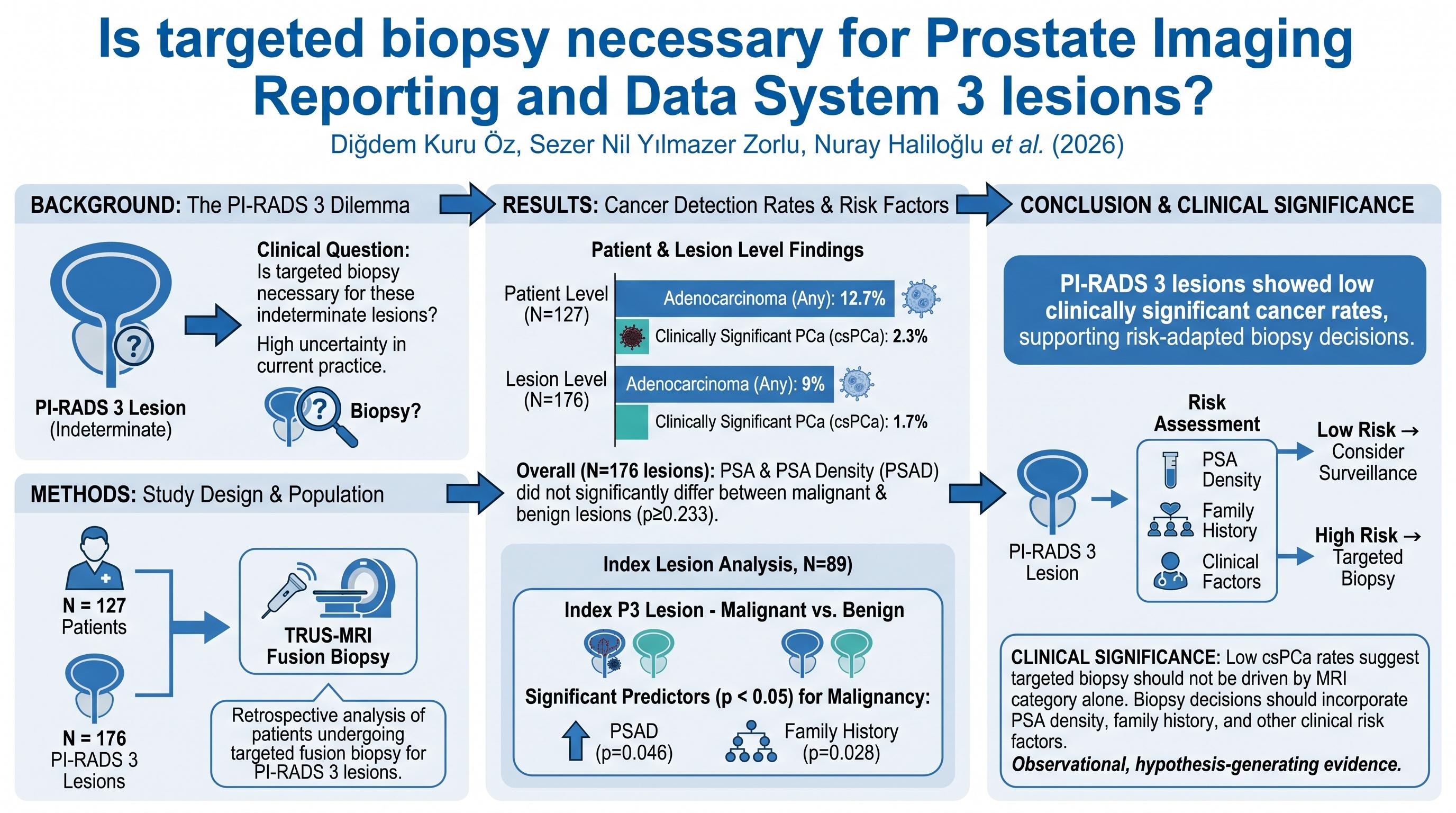
PI-RADS 3 lesions showed low clinically significant cancer rates, supporting risk-adapted biopsy decisions.
Lun-Hsiang Yuan, MD, PhD · 4 min read
Key points
- The study included 127 patients with 176 PI-RADS 3 lesions undergoing TRUS-MRI fusion biopsy.
- At the patient level, adenocarcinoma was found in 12.7% and clinically significant prostate cancer in only 2.3%.
- At the lesion level, adenocarcinoma was found in 9% and clinically significant prostate cancer in only 1.7%.
- Overall, PSA and PSA density did not differ significantly between malignant and benign PI-RADS 3 lesions (p≥0.233).
- Among 89 patients with an index P3 lesion, PSA density was higher in malignant patients (p=0.046), and family history was more common in malignant patients (p=0.028).
Review
PI-RADS 3 lesions remain one of the most difficult gray zones in MRI-directed prostate cancer workup: targeting all such lesions may increase low-yield invasive procedures, whereas ignoring them risks missing clinically significant cancer. This study evaluated the histopathology of PI-RADS version 2.1 category 3 lesions and whether targeted biopsy is essential. The cohort included 127 patients with 176 PI-RADS 3 lesions who underwent transrectal ultrasound–magnetic resonance imaging fusion biopsy. Mean age was 62.4 years; median PSA was 6.64 ng/mL, PSA density 0.10 ng/mL2, free PSA 1.24 ng/mL, and free/total PSA 0.18. Analyses were performed at both patient and lesion levels; the abstract does not specify whether the study was prospective or retrospective. The central clinical finding is that malignancy and clinically significant prostate cancer rates were low in PI-RADS 3 lesions. At the patient level, adenocarcinoma prevalence was 12.7% and clinically significant prostate cancer was 2.3%; at the lesion level, the corresponding rates were 9% and 1.7%. Cancer detected by systematic biopsy alone occurred in 7.8% of patients, with 1.5% clinically significant. PSA and PSA density did not differ significantly between malignant and benign PI-RADS 3 lesions overall (p≥0.233). However, among 89 patients whose index lesion was P3, PSA density was higher in malignant patients (p=0.046). Family history was also significantly more common in malignant patients (p=0.028). The authors interpret these data to suggest that, because clinically significant cancer is very uncommon in PI-RADS 3 lesions, biopsy decisions for patients with an index PI-RADS 3 lesion should incorporate clinical findings and risk factors. In patients with PI-RADS 4 or 5 index lesions, targeting additional PI-RADS 3 areas may be relevant for defining disease extent. Key limitations are that the abstract does not report follow-up duration, study period, the definition of clinically significant cancer, MRI field strength, or external validation; therefore, the findings should be treated as low-to-moderate level, hypothesis-generating clinical evidence.
Clinical Significance
This paper is clinically useful because it addresses the everyday biopsy dilemma of PI-RADS 3 lesions. The low rate of clinically significant cancer suggests that targeted biopsy for an index PI-RADS 3 lesion should not be driven by MRI category alone, but should incorporate PSA density, family history, and other clinical risk factors. Because the abstract does not specify prospective design, follow-up, or the definition of clinically significant cancer, this is observational, hypothesis-generating evidence rather than practice-changing proof.