Efficacy and safety of immunotherapy-based combination therapy as first-line treatment for advanced renal cell carcinoma: a systematic review and network meta-analysis
Pembrolizumab combinations rank high in first-line RCC.
Lun-Hsiang Yuan, MD, PhD · 5 min read
Key points
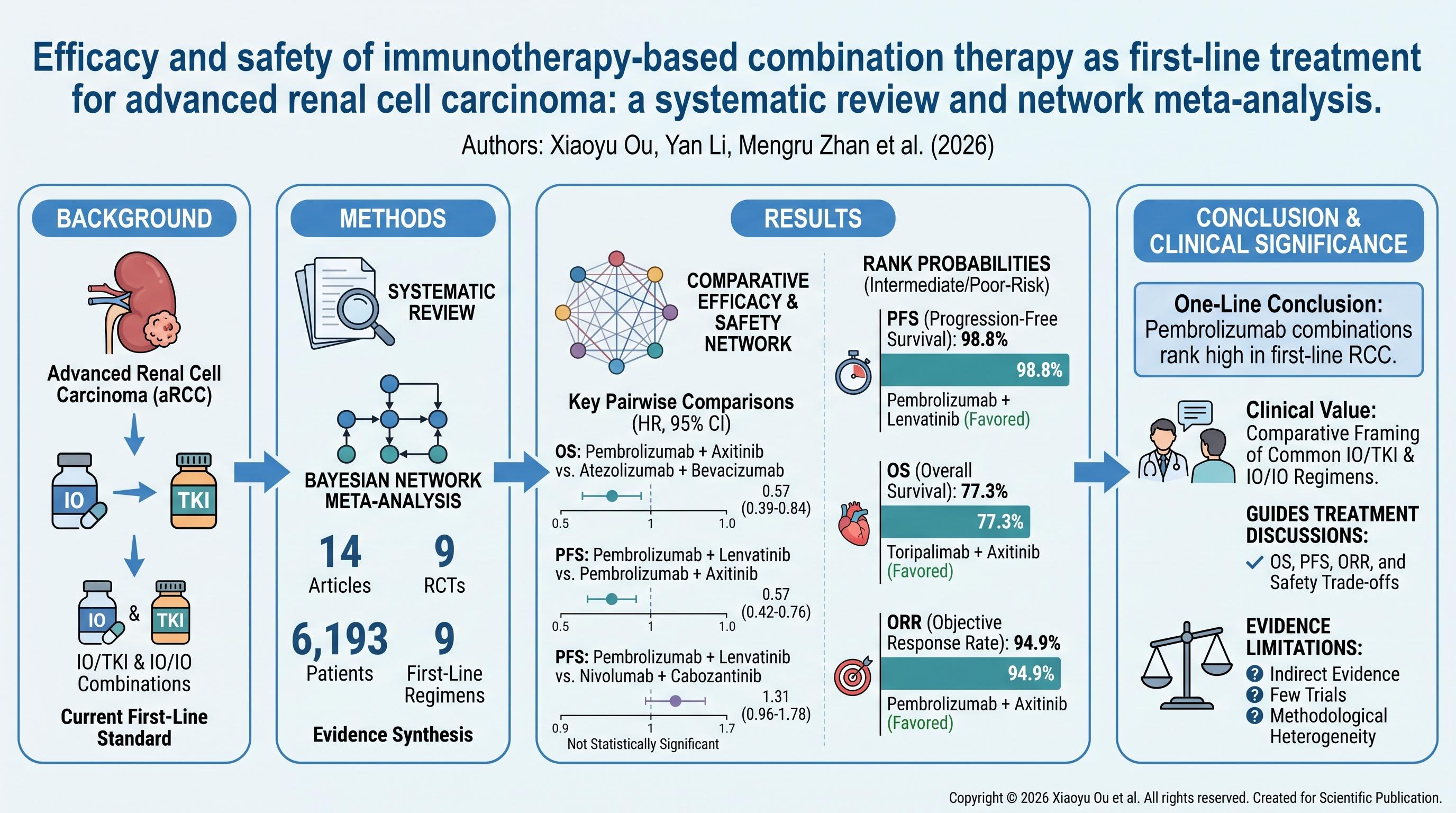
- The analysis included 14 articles, 9 RCTs, 6,193 patients, and 9 first-line immunotherapy-based regimens.
- Pembrolizumab plus axitinib improved OS versus atezolizumab plus bevacizumab (HR 0.57, 95% CI 0.39-0.84).
- Pembrolizumab plus lenvatinib improved PFS versus pembrolizumab plus axitinib (HR 0.57, 95% CI 0.42-0.76).
- The PFS comparison between pembrolizumab plus lenvatinib and nivolumab plus cabozantinib was not statistically significant (HR 1.31, 95% CI 0.96-1.78).
- In intermediate- and poor-risk patients, rank probabilities favored pembrolizumab plus lenvatinib for PFS at 98.8%, toripalimab plus axitinib for OS at 77.3%, and pembrolizumab plus axitinib for ORR at 94.9%.
Review
First-line treatment for advanced renal cell carcinoma now includes several immunotherapy-based combinations, but clinicians often lack direct head-to-head evidence to balance OS, PFS, ORR, and toxicity. This systematic review and Bayesian network meta-analysis searched PubMed, Embase, Web of Science, the Cochrane Library, and Chinese databases from inception to December 22, 2024. It included 14 articles, 9 randomized controlled trials, 6,193 patients, and 9 regimens. Short-term data were used for the primary analysis, while long-term and newly published RCT data were used for subgroup analyses. The abstract does not define a single primary endpoint; OS, PFS, ORR, and AEs were assessed using HRs and ORs in all-risk and intermediate- and poor-risk populations. In the all-risk population, pembrolizumab plus axitinib improved OS compared with atezolizumab plus bevacizumab (HR 0.57, 95% CI 0.39-0.84). Pembrolizumab plus lenvatinib showed superior PFS versus pembrolizumab plus axitinib (HR 0.57, 95% CI 0.42-0.76), while its comparison with nivolumab plus cabozantinib did not reach statistical significance (HR 1.31, 95% CI 0.96-1.78). For ORR, the abstract reports higher response with pembrolizumab plus lenvatinib versus pembrolizumab plus axitinib (OR 0.61, 95% CI 0.39-0.92). Rank probabilities identified pembrolizumab plus axitinib and pembrolizumab plus lenvatinib as leading options in all-risk populations. In intermediate- and poor-risk patients, rankings favored pembrolizumab plus lenvatinib for PFS (98.8%), toripalimab plus axitinib for OS (77.3%), and pembrolizumab plus axitinib for ORR (94.9%). The authors also note poorer safety for pembrolizumab plus lenvatinib compared with the better tolerability of nivolumab plus ipilimumab. Key limitations are the limited number of trials, methodological heterogeneity, indirect comparisons, reliance on ranking probabilities, and lack of absolute AE rates, ARR, or NNT in the abstract.
Clinical Significance
The clinical value is comparative framing: common first-line IO/TKI and IO/IO regimens for advanced RCC are evaluated within one RCT network, helping clinicians discuss OS, PFS, ORR, and safety trade-offs. This is RCT-based systematic review and Bayesian network meta-analysis evidence, but it remains largely indirect and limited by few trials and methodological heterogeneity.