Efficacy and safety of cytoreductive nephrectomy combined with thrombectomy in metastatic renal cell carcinoma with venous tumor thrombus: a real-world study based on inverse probability of treatment weighting
Surgical benefit in mRCC-VTT may depend on Mayo thrombus level.
Lun-Hsiang Yuan, MD, PhD · 4 min read
Key points
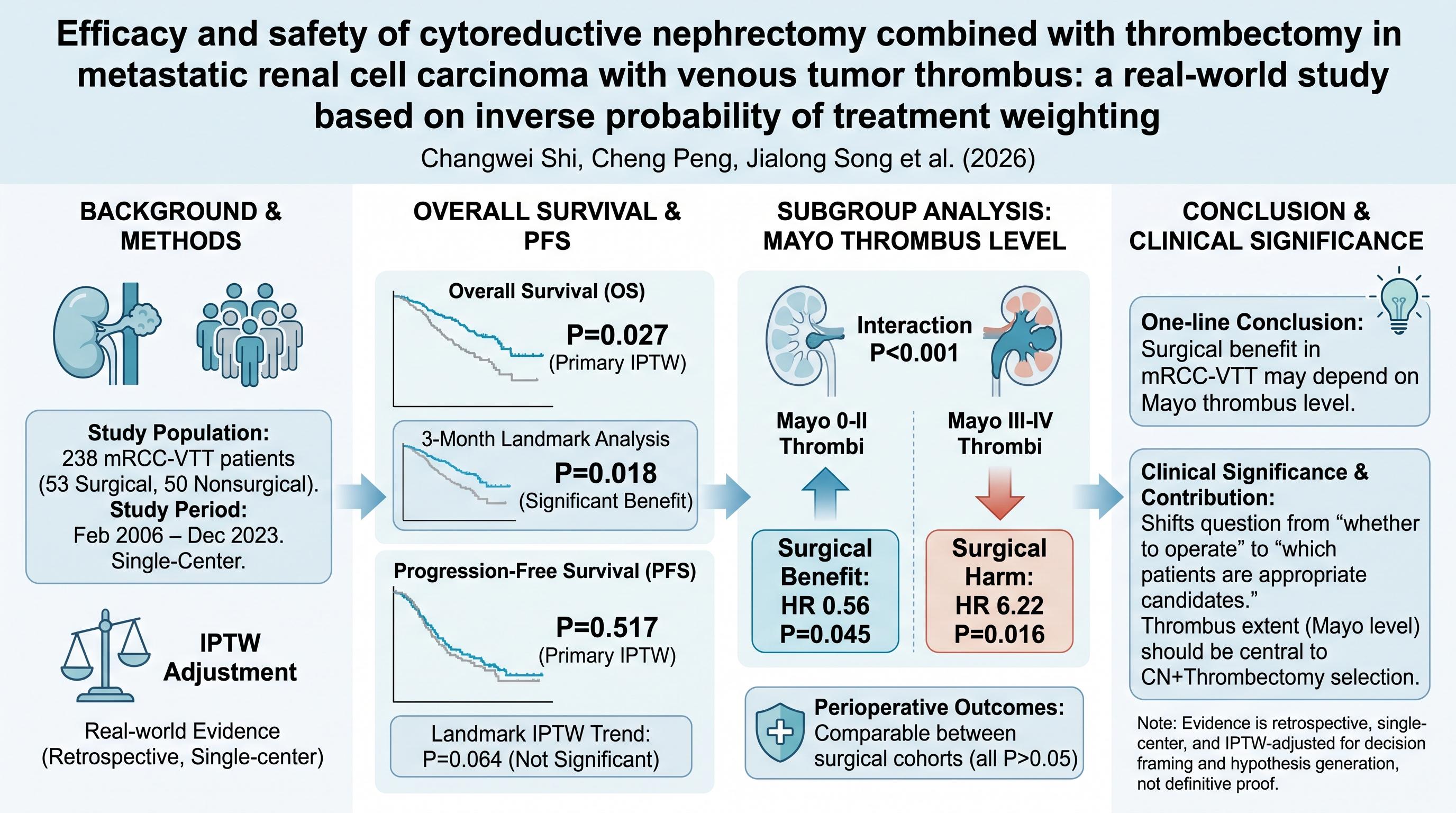
- This single-center study included 238 RCC-VTT patients treated from February 2006 to December 2023, including 53 metastatic surgical and 50 metastatic nonsurgical patients.
- After IPTW adjustment, CN plus thrombectomy was associated with longer OS in the metastatic cohort (P=0.027), remaining significant in the 3-month landmark analysis (P=0.018).
- PFS was not significantly different in the primary IPTW analysis (P=0.517) and showed only a nonsignificant favorable trend after landmark IPTW (P=0.064).
- Mayo level modified the OS association (interaction P<0.001): surgery was associated with HR 0.56 in Mayo 0-II thrombi (P=0.045) but HR 6.22 in Mayo III-IV thrombi (P=0.016).
- Perioperative outcomes were comparable between metastatic and nonmetastatic surgical cohorts (all P>0.05), but the evidence remains retrospective and single-center.
Review
Whether cytoreductive nephrectomy (CN) plus thrombectomy should be used for metastatic renal cell carcinoma with venous tumor thrombus (mRCC-VTT) remains controversial, and patient selection is the central clinical problem. This single-center retrospective real-world study analyzed 238 patients with RCC-VTT treated between February 2006 and December 2023, categorized as nonmetastatic surgical RCC-VTT (n=135), metastatic surgical RCC-VTT (n=53), or metastatic nonsurgical RCC-VTT (n=50). The investigators used inverse probability of treatment weighting (IPTW) to reduce measured confounding and assessed perioperative outcomes, overall survival (OS), progression-free survival (PFS), subgroup heterogeneity, and a 3-month landmark sensitivity analysis. After IPTW adjustment, perioperative outcomes were comparable between metastatic and nonmetastatic surgical cohorts, with all P values >0.05. Within the metastatic cohort, surgery was associated with longer OS than nonsurgical management (P=0.027), and this association remained statistically significant in the 3-month landmark analysis after re-estimating IPTW (P=0.018). PFS did not differ significantly after the primary IPTW adjustment (P=0.517), and after landmark IPTW showed only a nonsignificant favorable trend (P=0.064). Mayo thrombus level was a key effect modifier for both OS (P for interaction <0.001) and PFS (P for interaction=0.034). For OS, surgery was associated with longer survival in Mayo 0-II thrombi (HR 0.56, P=0.045), whereas patients with Mayo III-IV thrombi had worse outcomes after surgery (HR 6.22, P=0.016). The authors conclude that CN plus thrombectomy appeared feasible and was associated with improved OS in selected mRCC-VTT patients, particularly those with low-level thrombi, while systemic therapy-first strategies should be considered for high-level thrombi. Because this was retrospective and single-center, and IPTW only addresses measured confounding, the findings should be viewed as selection-guiding and hypothesis-generating rather than definitive.
Clinical Significance
The practical contribution is shifting the mRCC-VTT surgery question from whether to operate to which patients may be appropriate candidates. The opposite OS associations by Mayo 0-II versus Mayo III-IV thrombus level suggest thrombus extent should be central to CN plus thrombectomy selection. This is retrospective, single-center, IPTW-adjusted real-world evidence, useful for decision framing and hypothesis generation but not definitive practice-changing proof.