Participant Heterogeneity in the Prostate Cancer Biobank of the NRG: An Obstacle to Broadening the Reach of Precision Oncology
NRG prostate cancer biobanks show representation gaps relevant to precision oncology.
Lun-Hsiang Yuan, MD, PhD · 4 min read
Key points
- Across 19 NRG prostate cancer trials, 11,796 of 15,648 randomized patients eligible for biospecimen collection had specimens submitted (75%).
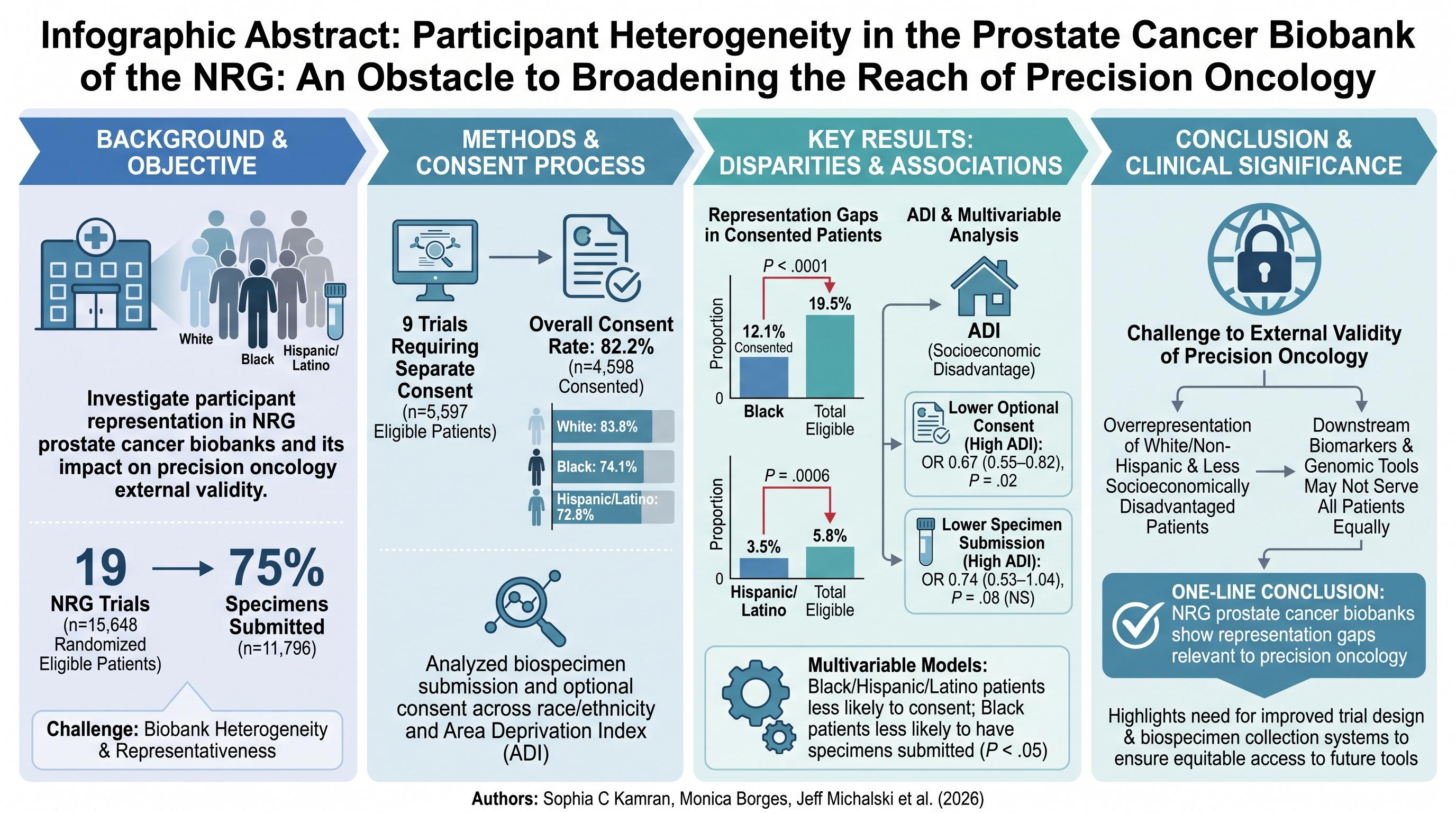
- In nine trials requiring separate consent, 4,598 of 5,597 eligible patients consented (82.2%); consent rates were 74.1% for Black, 72.8% for Hispanic/Latino, and 83.8% for White patients.
- Patients who consented included lower proportions of Black patients (12.1% vs 19.5%, P < .0001) and Hispanic/Latino patients (3.5% vs 5.8%, P = .0006).
- High ADI was associated with lower optional biospecimen consent (OR 0.67, 95% CI 0.55–0.82; P = .02), but biospecimen submission did not reach statistical significance (OR 0.74, 95% CI 0.53–1.04; P = .08).
- In multivariable models, Black/Hispanic/Latino patients were less likely to consent, and Black patients were less likely to have biospecimens submitted (P < .05 for all).
Review
Precision oncology depends on tumor biomarkers, but biomarker datasets can become less generalizable when biospecimen repositories do not reflect the broader cancer population. This study reviewed 19 NRG Oncology prostate cancer clinical trials closed before 2015 to evaluate demographic differences in optional biospecimen collection consent and actual biospecimen submission among randomized trial participants. Variables included race, ethnicity, median income, area deprivation index (ADI; highest versus lowest three quartiles), age at enrollment, site, and year of enrollment. The authors used t tests or chi-square tests followed by logistic regression. Among 15,648 randomized patients eligible for biospecimen collection, 11,796 (75%) had specimens submitted. In nine trials with a separate optional biospecimen consent process, 4,598 of 5,597 eligible patients consented (82.2%); consent rates were 74.1% for Black patients, 72.8% for Hispanic/Latino patients, and 83.8% for White patients. Compared with patients who did not consent, those who consented included smaller proportions of Black patients (12.1% vs 19.5%, P < .0001) and Hispanic/Latino patients (3.5% vs 5.8%, P = .0006). In univariable logistic regression, high ADI, reflecting greater socioeconomic disadvantage, was associated with a lower likelihood of optional biospecimen consent (OR 0.67, 95% CI 0.55–0.82; P = .02), but not a statistically significant lower likelihood of biospecimen submission (OR 0.74, 95% CI 0.53–1.04; P = .08). Multivariable models showed that Black/Hispanic/Latino patients were less likely to consent to optional biospecimen collection, and Black patients were less likely to have biospecimens submitted (P < .05 for all). The authors conclude that targeted solutions are needed to improve biorepository representation. As a retrospective analysis of large cooperative-group trial data, the study is highly informative for trial infrastructure and precision oncology validity, but it does not test an intervention.
Clinical Significance
The clinical value is not a change in a specific treatment choice, but a challenge to the external validity of precision oncology. If biobanks overrepresent White/non-Hispanic patients and those with less socioeconomic disadvantage, downstream biomarkers and genomic tools may not serve all patients equally. This is retrospective evidence from large cooperative-group clinical trial datasets, most useful for improving trial design and biospecimen collection systems.