Prostate-Specific Antigen Screening Patterns and Metastatic Prostate Cancer in US Veterans
Earlier, more regular PSA testing was associated with lower metastatic diagnosis risk.
Lun-Hsiang Yuan, MD, PhD · 4 min read
Key points
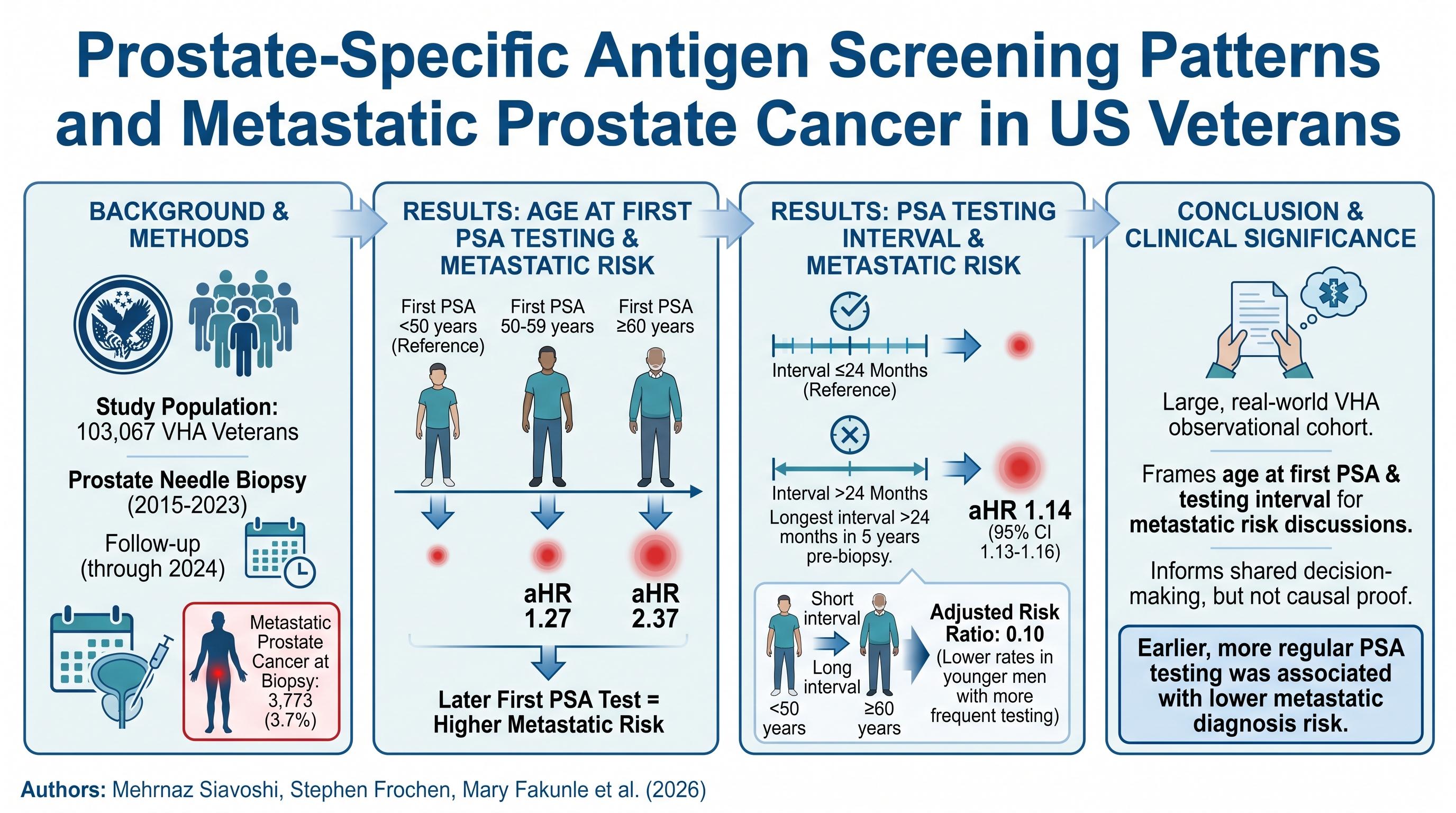
- The study included 103,067 VHA veterans who underwent prostate needle biopsy from 2015 through 2023, with follow-up through 2024.
- At biopsy, 3,773 participants (3.7%) were diagnosed with metastatic prostate cancer.
- Compared with first PSA testing before age 50, first testing at ages 50–59 and ≥60 years was associated with higher metastatic prostate cancer risk, with adjusted HRs of 1.27 and 2.37.
- A longest PSA testing interval >24 months in the 5 years before biopsy was associated with higher metastatic prostate cancer risk, with an adjusted HR of 1.14 (95% CI 1.13–1.16).
- Men younger than 50 years with PSA intervals ≤24 months had lower metastatic prostate cancer rates than men aged ≥60 years with intervals >24 months, with an adjusted risk ratio of 0.10.
Review
This large VHA cohort study addresses a clinically important question in prostate cancer care: as PSA screening recommendations have changed and metastatic prostate cancer incidence has risen in US men, what contemporary PSA testing patterns are associated with metastatic disease at diagnosis in a large health system? The investigators included 103,067 veterans without prior prostate cancer who underwent prostate needle biopsy in the Veterans Health Administration from January 2015 through December 2023, with follow-up through 2024; analyses were performed from July 1, 2023, to November 6, 2025. PSA testing was categorized by age at first VA PSA test (<50, 50–59, or ≥60 years) and by the longest interval between consecutive VA PSA tests in the 5 years before biopsy (≤24 vs >24 months). Multivariable Cox models, adjusted for sociodemographic and clinical covariates, estimated risk from first VA PSA to first biopsy and compared metastatic regional or distant prostate cancer with localized prostate cancer or benign diagnosis. Among participants, 20,233 (19.6%) were younger than 50 years at first PSA; 31,546 (30.6%) were non-Hispanic Black, 58,264 (56.5%) were non-Hispanic White, and 13,277 (12.9%) had other race or ethnicity. A first PSA value ≤1 ng/mL was seen in 22,190 (21.5%), 52,939 (51.4%) had a screening interval ≤24 months, and 3,773 (3.7%) were diagnosed with metastatic prostate cancer at biopsy. Compared with men younger than 50 years at first PSA, those first tested at ages 50–59 and ≥60 years had higher metastatic prostate cancer risk, with adjusted HRs of 1.27 (95% CI 1.24–1.29) and 2.37 (95% CI 2.33–2.42), respectively. Longer screening intervals were also associated with higher risk, with an adjusted HR of 1.14 (95% CI 1.13–1.16). Men younger than 50 years with shorter intervals had lower metastatic prostate cancer rates than men aged ≥60 years with longer intervals, with an adjusted risk ratio of 0.10 (95% CI 0.09–0.12). The authors conclude that few veterans had the most favorable screening-factor combinations, suggesting room to optimize PSA screening. Because this is an observational cohort of men who underwent biopsy, the findings support risk-informed screening discussions but do not prove that earlier or more frequent PSA testing causally prevents metastasis.
Clinical Significance
This is a large, contemporary, real-world VHA observational cohort, stronger than small single-center retrospective series but not randomized evidence. Its main clinical value is to frame age at first PSA testing and subsequent testing interval as practical context for metastatic prostate cancer risk discussions. The data can inform shared decision-making about PSA screening timing and follow-up density, but should not be read as causal proof that any fixed screening schedule prevents metastasis.