AI-MIRACLE: Artificial Intelligence and MultIpaRAmetric MRI Predict CLinical OutcomEs to Neoadjuvant Immunotherapy in Patients with Muscle-invasive Bladder Cancer Undergoing Radical Cystectomy
Post-ICI mpMRI radiomics may predict MIBC pathological response.
Lun-Hsiang Yuan, MD, PhD · 4 min read
Key points
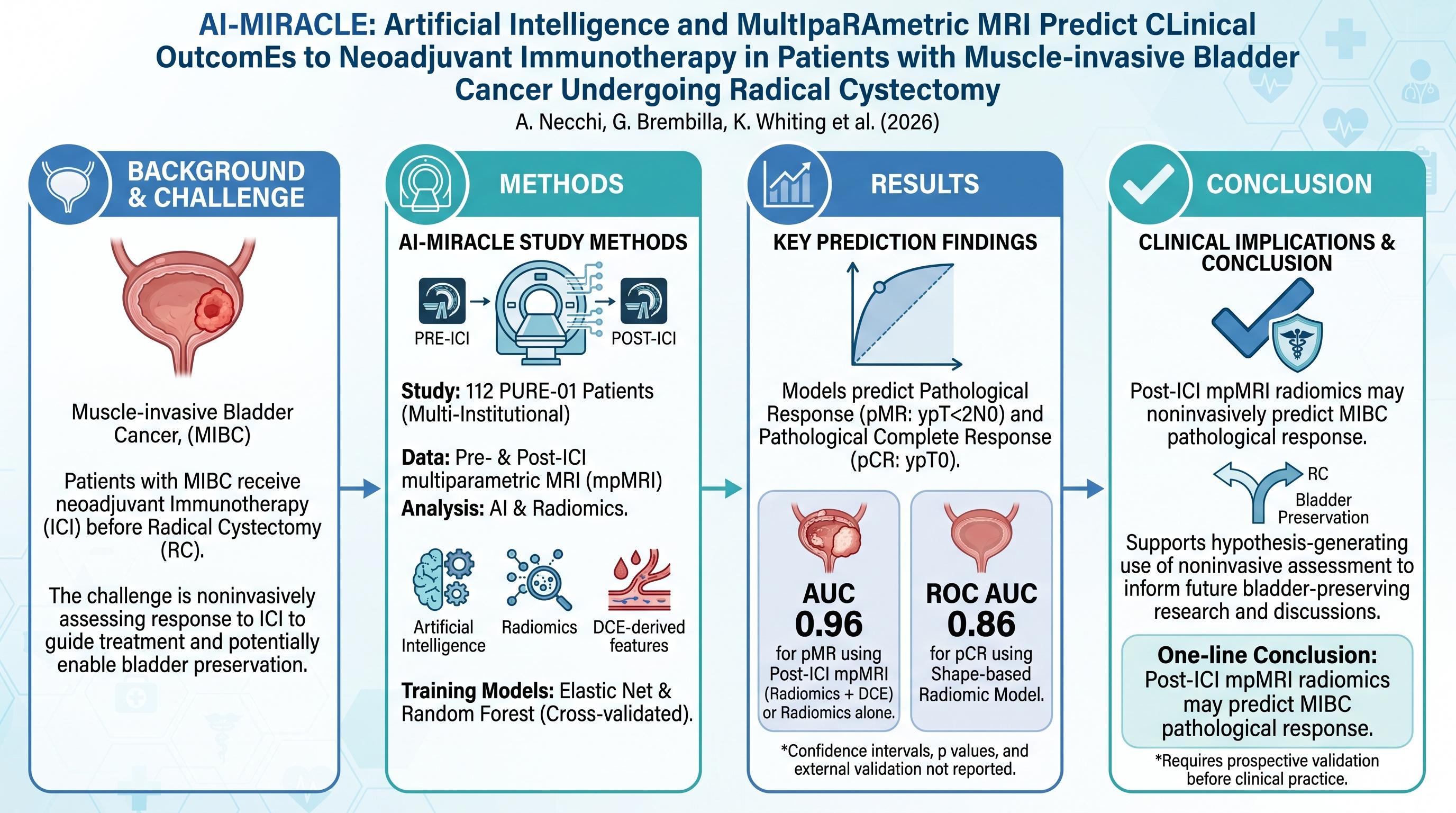
- The study analyzed pre- and post-ICI MRI from 112 PURE-01 patients to predict pMR, defined as ypT<2N0, and pCR, defined as ypT0.
- Post-ICI mpMRI models using radiomics plus DCE-derived features or radiomics alone both achieved an AUC of 0.96 for pMR.
- A shape-based radiomic model achieved a ROC AUC of 0.86 for predicting pCR.
- Elastic net and random forest models were trained and cross-validated; the abstract does not report external validation, confidence intervals, or p values.
- The work supports hypothesis-generating use of noninvasive response assessment after neoadjuvant pembrolizumab to inform bladder-preserving research.
Review
For muscle-invasive bladder cancer (MIBC), neoadjuvant immune-checkpoint inhibitors have been studied in patients ineligible for cisplatin-based chemotherapy; the PURE-01 trial (NCT02736266) evaluated three courses of pembrolizumab before radical cystectomy (RC). AI-MIRACLE extends this setting by testing whether artificial intelligence applied to multiparametric MRI (mpMRI) can predict pathological response after neoadjuvant immunotherapy. This was an international, multi-institutional study with image acquisition in Italy and centralized analysis in the United States. Among 112 PURE-01 patients, both pre- and post-ICI MRIs were analyzed. T2-weighted signal intensities were standardized for radiomics using IBSI-compatible pyCERR and for deep feature extraction using the AI-BLADE toolbox with VGG19. Diffusion-weighted and dynamic contrast-enhanced MRI data underwent model-based analysis. Supervised machine-learning algorithms, including elastic net and random forest, were trained and cross-validated to predict pathological major response, defined as ypT<2N0 residual disease, and pathological complete response, defined as ypT0. Key results centered on post-ICI mpMRI: models using either radiomics plus DCE-derived features or radiomics alone achieved an AUC of 0.96 for predicting pMR. A shape-based radiomic model achieved a ROC AUC of 0.86 for predicting pCR. The authors state that these models outperformed benchmark models based on clinical predictors, although the abstract does not provide effect sizes, confidence intervals, or p values for that comparison. Clinically, shape-based radiomics, DCE-derived features, and deep features may become noninvasive imaging biomarkers for response assessment after neoadjuvant pembrolizumab and may help inform bladder-preserving management before definitive surgery. The important caveat is that this remains a predictive modeling study with cross-validation described in the abstract, so its use in decision-making requires prospective validation.
Clinical Significance
This is directly relevant to urologic oncology because post-treatment mpMRI radiomics may, if prospectively validated, support noninvasive response assessment before radical cystectomy and inform bladder-preservation discussions. The evidence remains a multi-institutional modeling study with cross-validation, not practice-changing proof.