First-Line Treatment Strategies in IMDC Favourable-Risk Metastatic Clear Cell Renal Cell Carcinoma
Individualize first-line care in favorable-risk mccRCC.
Lun-Hsiang Yuan, MD, PhD · 5 min read
Key points
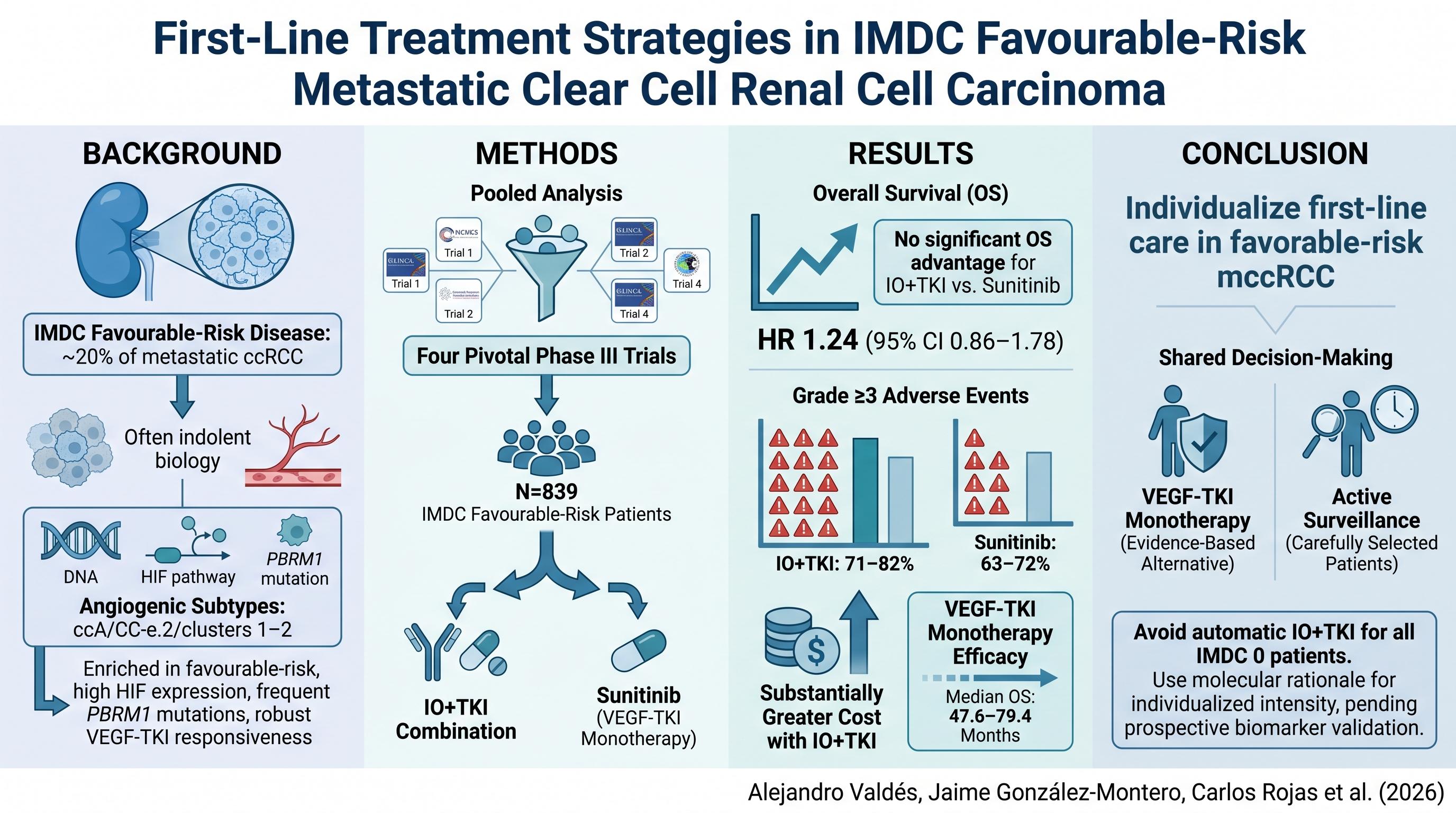
- A pooled analysis of four pivotal phase III trials included 839 IMDC favourable-risk patients, with no significant OS advantage for IO+TKI versus sunitinib: HR 1.24, 95% CI 0.86–1.78.
- Grade ≥3 adverse events were 71–82% with IO+TKI versus 63–72% with sunitinib, and the abstract notes substantially greater cost with IO+TKI.
- IMDC favourable-risk disease represents approximately 20% of metastatic ccRCC and is often characterized by indolent disease biology.
- VEGF-TKI monotherapy had a reported median OS of 47.6–79.4 months, and the authors frame it alongside active surveillance as an evidence-based alternative for carefully selected patients.
- Angiogenic subtypes, including ccA/CC-e.2/clusters 1–2, are enriched in favourable-risk disease and associated with high HIF pathway expression, frequent PBRM1 mutations, and robust VEGF-TKI responsiveness.
Review
This article addresses a very practical question in IMDC favourable-risk metastatic clear cell renal cell carcinoma: should first-line IO+TKI be the default for everyone with IMDC score 0 disease? Current guidelines favor ICI plus VEGF-TKI combinations in this subgroup, largely because of improved objective response rates and progression-free survival. However, the abstract emphasizes that no IO+TKI regimen has demonstrated a statistically significant overall survival benefit in favourable-risk patients. The key evidence summarized is a pooled analysis of four pivotal phase III trials including 839 favourable-risk patients, comparing IO+TKI with sunitinib monotherapy. The abstract does not define a primary versus secondary endpoint hierarchy for this article, so the findings should be read as an integrated clinical analysis rather than a confirmatory de-escalation trial. The central OS result does not support universal treatment intensification: IO+TKI versus sunitinib had an HR of 1.24 with a 95% CI of 0.86–1.78, crossing 1 and therefore not statistically significant. Toxicity is also important: grade ≥3 adverse events were reported in 71–82% with IO+TKI versus 63–72% with sunitinib, and the abstract notes substantially greater cost with IO+TKI. The biologic argument is also clinically relevant. IMDC favourable-risk disease represents approximately 20% of metastatic ccRCC and is often characterized by indolent biology. Emerging molecular classifications identify angiogenic subtypes, including ccA/CC-e.2/clusters 1–2, enriched in favourable-risk patients and characterized by high HIF pathway gene expression, frequent PBRM1 mutations, robust VEGF-TKI responsiveness, and comparatively lower benefit from immunotherapy. The authors therefore interpret VEGF-TKI monotherapy, with median OS of 47.6–79.4 months, and active surveillance as evidence-based alternatives for carefully selected favourable-risk patients, particularly those with asymptomatic, metachronous, or otherwise indolent disease. The main caveat is that current clinical risk stratification does not capture this molecular heterogeneity; predictive biomarkers and refined molecular risk models still require development and validation.
Clinical Significance
Clinically, this paper argues against treating all IMDC score 0 metastatic ccRCC patients as automatic IO+TKI candidates. The evidence level is a pooled analysis of favourable-risk subgroups from four pivotal phase III trials, supported by molecular subtype rationale. It is useful for shared decision-making and individualized intensity of care, but prospective biomarker validation is still needed.